Practical advantage of non-Hermitian enhanced quantum sensing
Kun Yang, Yaoming Chu, Musang Gong, Ning Wang, Jianming Cai,arXiv: 2603.20612
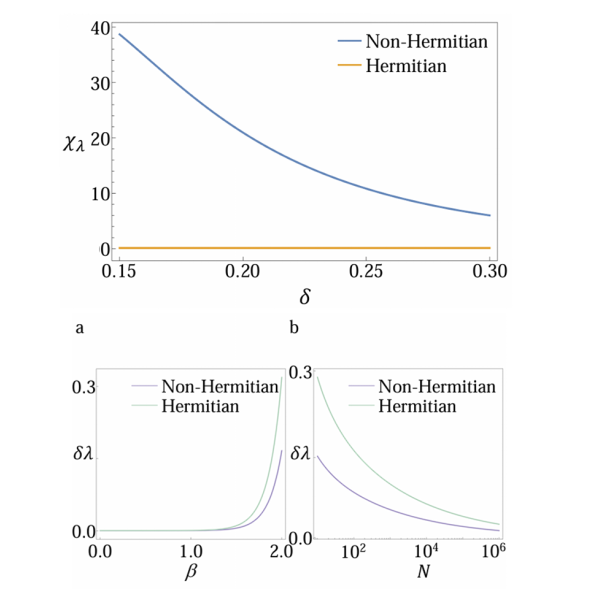
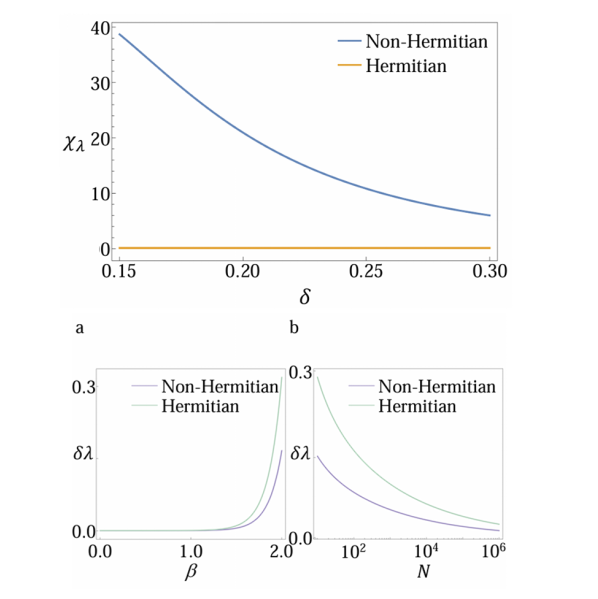
Non-Hermitian systems have emerged as a powerful paradigm for ultrasensitive sensing, leveraging unique spectral and dynamical properties that find no counterparts in Hermitian physics. While recent theoretical assessments have established that these protocols offer no fundamental advantage in the ideal shot-noise-limited regime once the success probability of non-unitary evolution is rigorously accounted for, their practical utility under realistic experimental constraints remains largely unexplored. In this work, we shift the focus toward practical laboratory performance by demonstrating that non-Hermitian sensors can significantly outperform their Hermitian counterparts in the presence of various types of technical noise. This enhancement stems from the significantly enhanced susceptibility, which amplifies the signal response to effectively overcome the floor of technical imperfections. By evaluating the Fisher information under different technical noise models, we further substantiate the superior performance of non-Hermitian sensing. Our results delineate the specific regimes where non-Hermitian platforms yield clear practical gains, offering a concrete avenue for building high-precision, noise-resilient sensors.