High-resolution wide-field magnetic imaging with sparse sampling using nitrogen-vacancy center
Keqing Liu, Jiazhao Tian, Bokun Duan, Hao Zhang, Kangze Li, GuofengZhang, Fedor Jelezko, Ressa S. Said, Jianming Cai and Liantuan Xiao ,arXiv:2602.00679
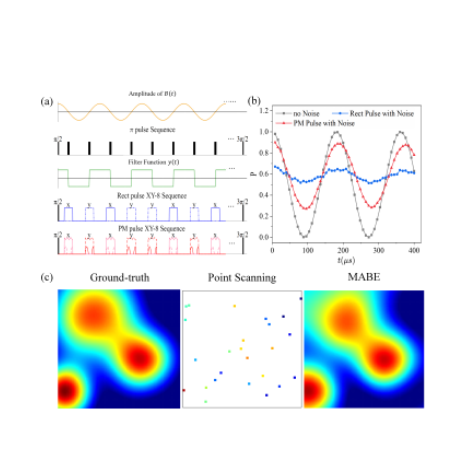
Nitrogen–vacancy (NV) centers in diamond enable quantitative magnetic imaging, yet practical implementations must balance spatial resolution against acquisition time (and thus per-pixel sensitivity). Single-NV scanning magnetometry achieves genuine nanoscale resolution, nonetheless requires typically a slow pixel-by-pixel acquisition. Meanwhile, wide-field NV-ensemble microscopy provides parallel readout over a large field of view, however is jointly limited by the optical diffraction limit and the sensor–sample standoff. Here, we present a sparse-sampling strategy for reconstructing high-resolution wide-field images from only a small number of measurements. Using simulated NV-ensemble detection of ac magnetic fields, we show that a mean-adjusted Bayesian estimation (MABE) framework can reconstruct 104-pixel images from only 25 sampling points, achieving SSIM values exceeding 0.999 for representative smooth field distributions, while optimized dynamical-decoupling pulse sequences yield an approximately twofold improvement in magnetic-field sensitivity. The method further clarifies how sampling patterns and sampling density affect reconstruction accuracy and suggests a route toward faster and more scalable magnetic-imaging architectures that may extend to point-scanning NV sensors and other magnetometry platforms, such as SQUIDs, Hall probes, and magnetic tunnel junctions